See the crack, not the blur.
Standard DIC smooths displacement across a discontinuity. Argos2D puts the jump inside the correlation, so cracks, twins and slip bands come out sharp. Three methods in one GPU-native tool: classic subset DIC, Heaviside enrichment and neural correlation.
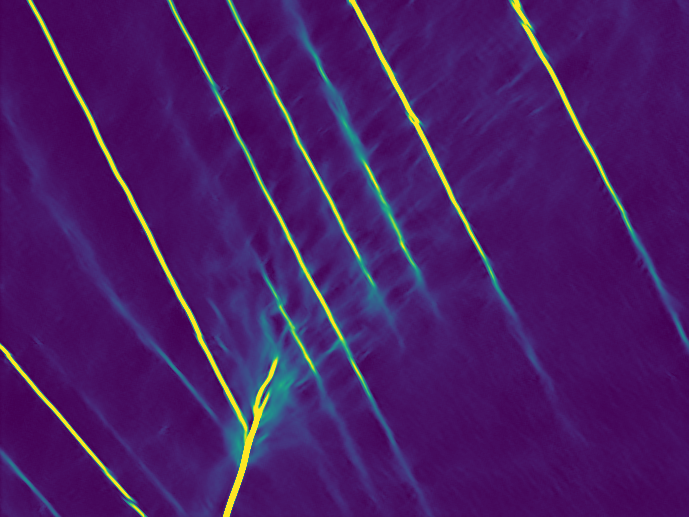
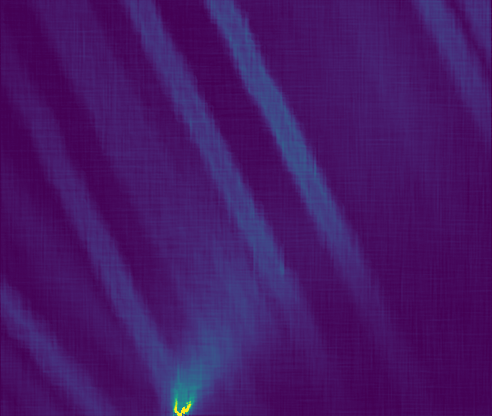
Effective strain (0 to 10 %) computed on the multi-modal dataset of J.C. Stinville, J.M. Hestroffer, M.A. Charpagne, A.T. Polonsky, M.P. Echlin, C.J. Torbet, V. Valle, K.E. Nygren, M.P. Miller, O. Klaas, A. Loghin, I.J. Beyerlein, T.M. Pollock, Scientific Data 9 (2022) 460. Argos2D result: neural correlation.
Method 2
Heaviside-Enriched DIC
Standard DIC assumes continuous displacement inside each subset, which smears out discontinuities across several pixels. Argos adds a Heaviside step function to the correlation model, allowing a sharp jump to be identified within each subset.
The subset shape function is augmented with a jump vector and a Heaviside function.
Used in Science Developed by V. Valle and co-workers at Institut PPRIME, Université de Poitiers. Method F. Bourdin et al., Measurements of plastic localization by heaviside-digital image correlation, Acta Materialia 157 (2018) 307–325. DOI Used in J.C. Stinville et al., On the origins of fatigue strength in crystalline metallic materials, Science 377 (2022) 1065–1071. DOI
Method 3
Neural Correlation (xR-DIC)
xR-DIC is derived from the RAFT optical flow architecture, heavily modified for digital image correlation and trained on synthetic speckle images. It runs locally on your GPU: your images never leave your computer.
- Per-pixel field: no subset size or spacing to tune
- Fracture tab: cracks detected and measured directly on the neural field
- Licensed option: the model and its engine are downloaded once, on first use
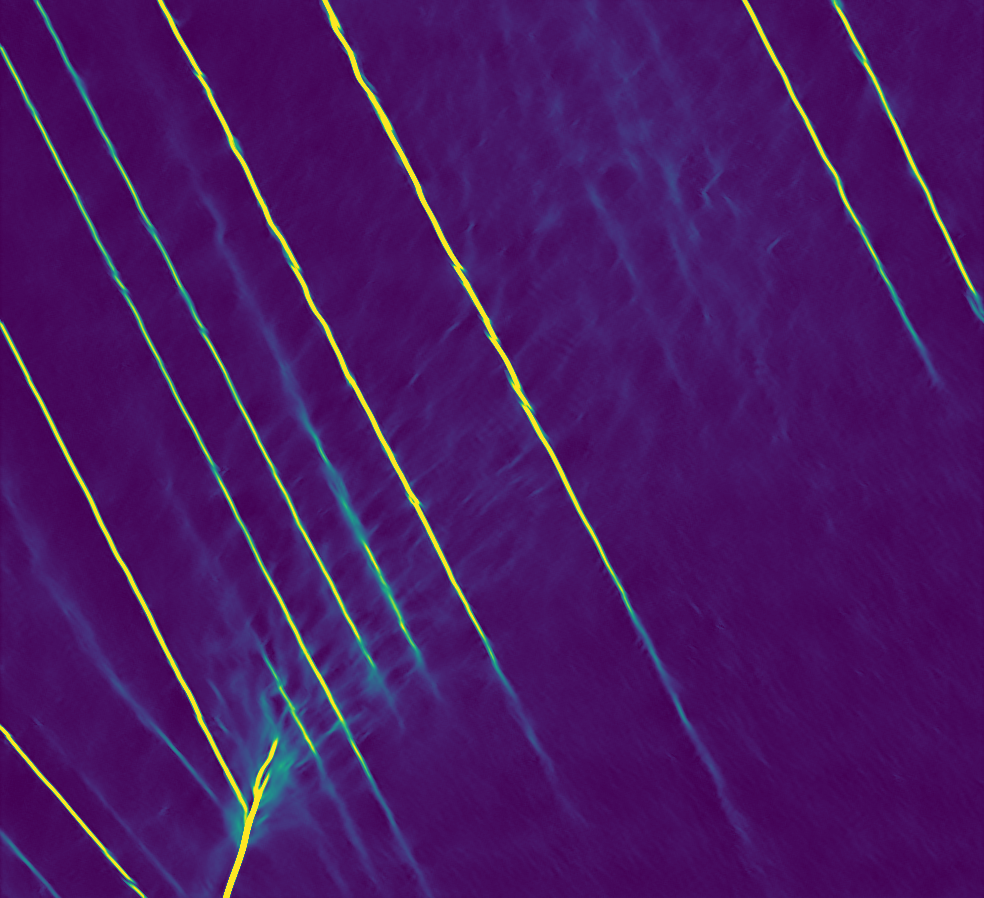
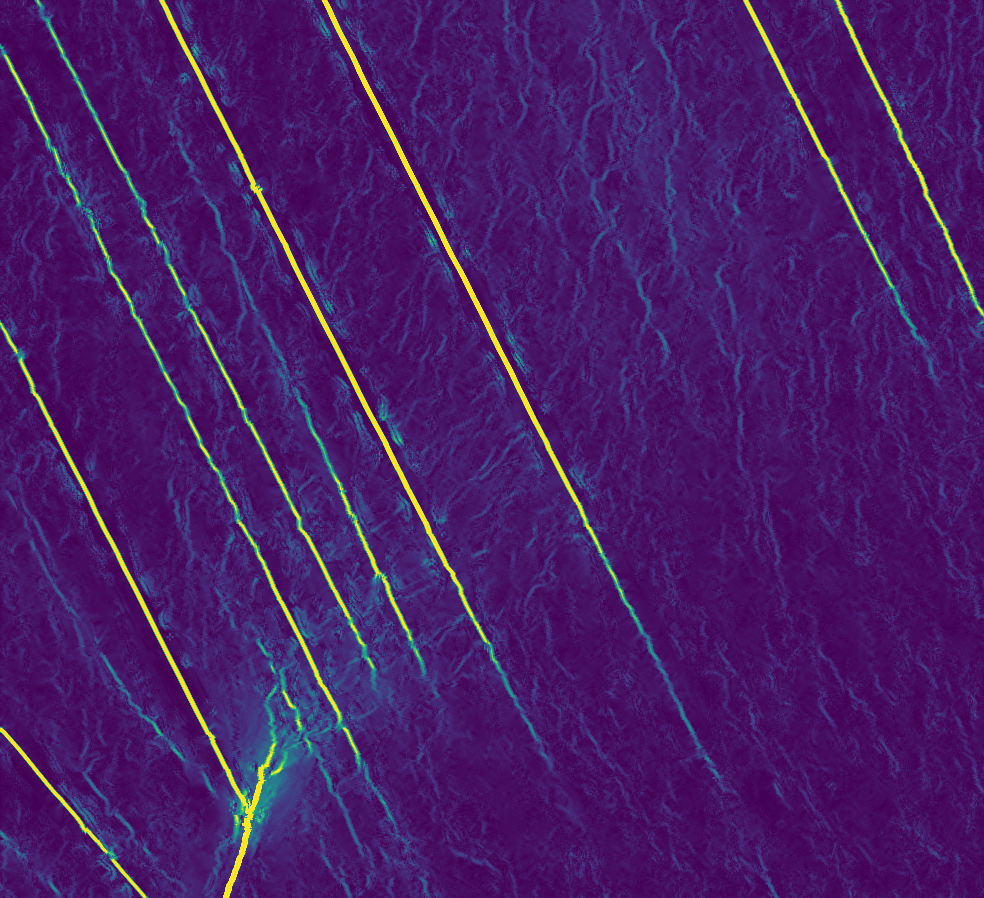
Comparison of the effective strain between H-DIC and xR-DIC, on the dataset of J.C. Stinville et al., Scientific Data 9 (2022) 460.
A full GUI to set up correlations and explore the results.
Interactive Visualization
Load your images, draw the region of interest, run the correlation, then browse displacement, strain and fracture maps in the same window, with synchronized views, line profiles and per-field contrast.
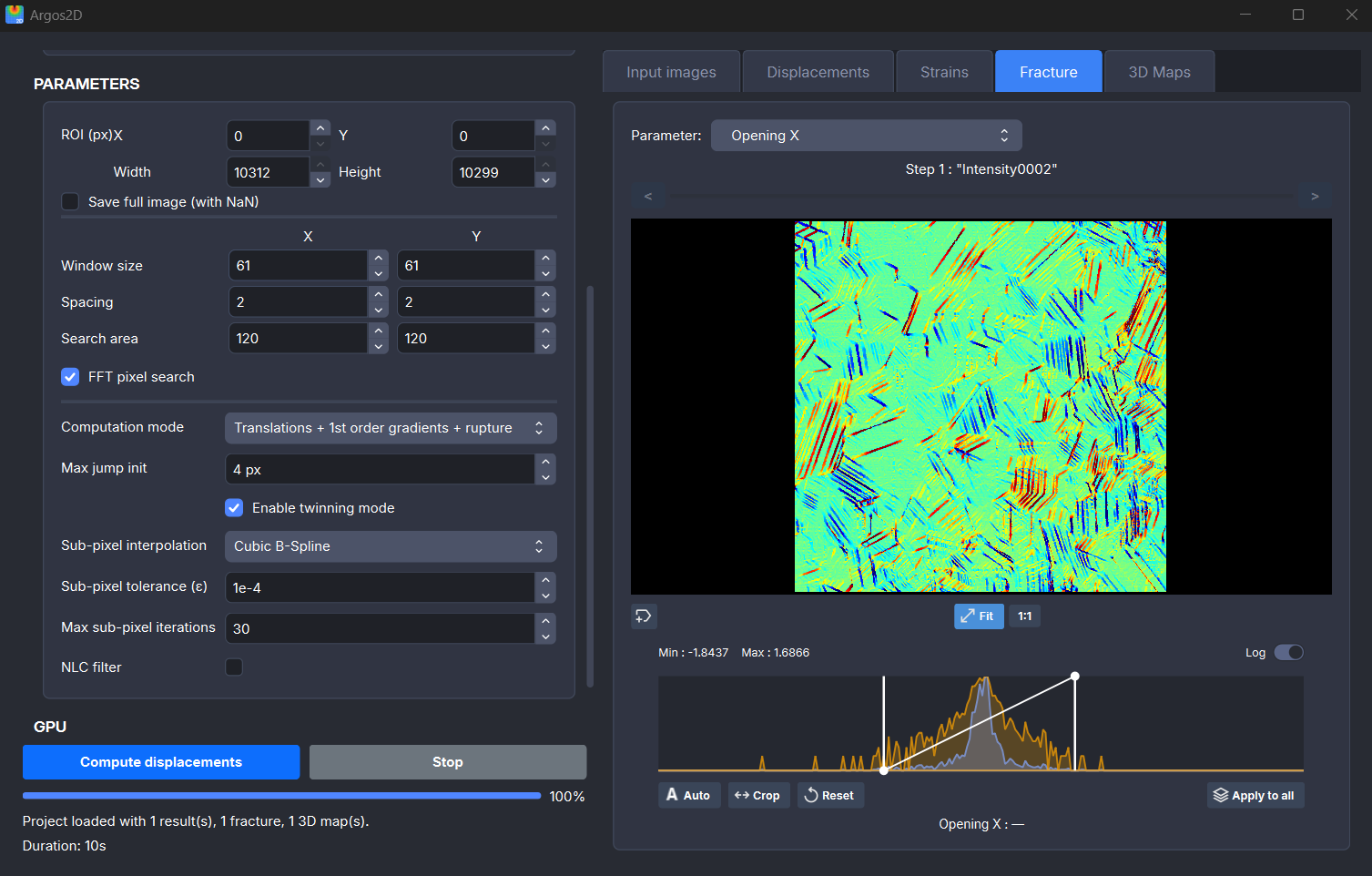
Dataset from A. Rouwane, D. Texier, J.-N. Périé, J.-E. Dufour, J.C. Stinville et al., Optics and Laser Technology, Vol. 177, 2024. Courtesy of Damien Texier.
Dedicated post-processing for cracks, twins and slip bands.
Fracture & Discontinuity Analysis
The fracture tab exposes the full enrichment output: crack opening displacement (intensity and direction), crack angle α, opening direction β, and a crystallographic decomposition into screw (longitudinal) and edge (transverse) components relative to the crack front.
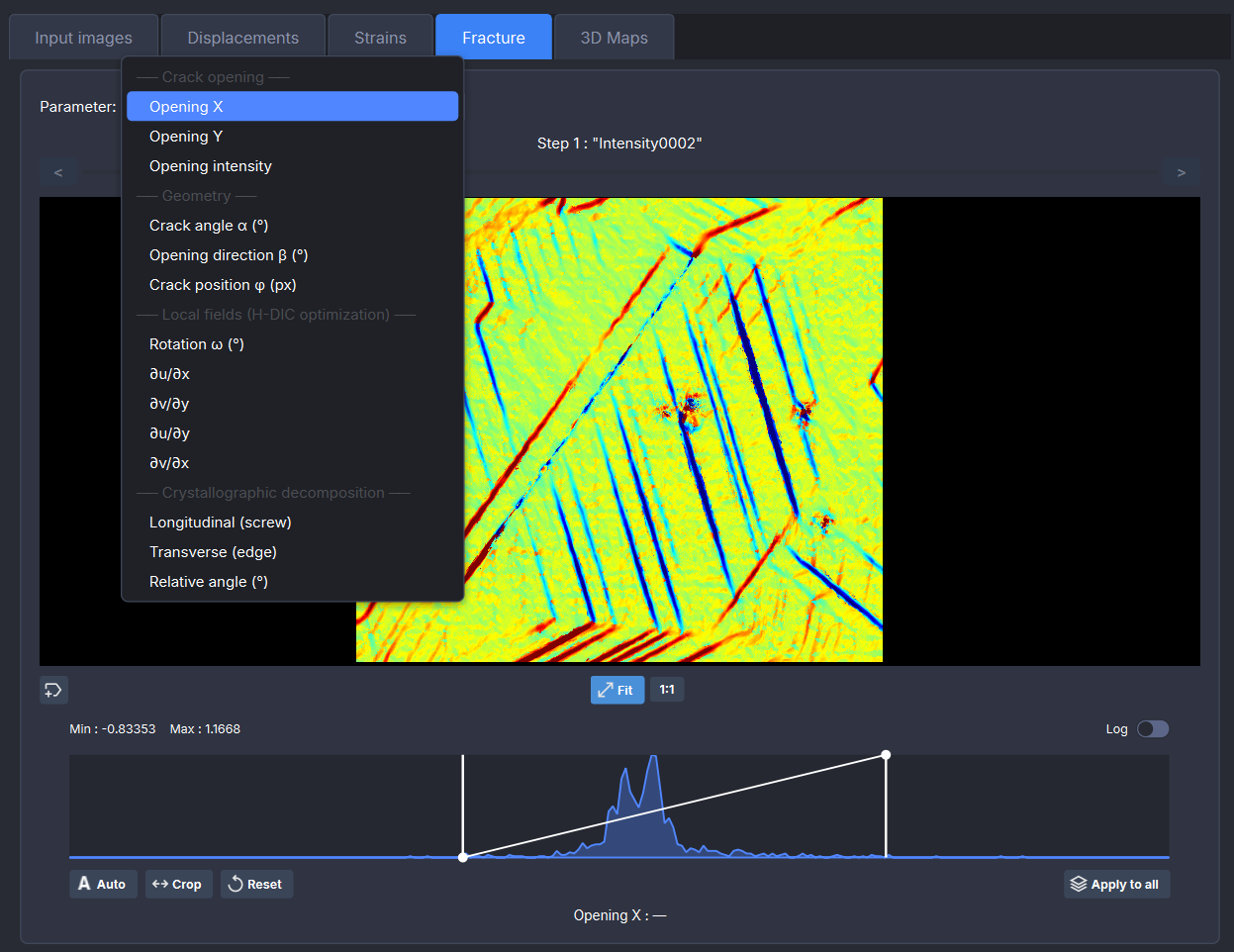
Dataset from A. Rouwane, D. Texier, J.-N. Périé, J.-E. Dufour, J.C. Stinville et al., Optics and Laser Technology, Vol. 177, 2024. Courtesy of Damien Texier.
Customizable derivative kernels and built-in criteria.
Strain Post-Processing
Compute the full strain tensor (εxx, εyy, εxy) from displacement fields using separable gradient operators.
- Separable gradient kernels — Sobel, Scharr, centered finite differences, or custom
- Custom expressions — built-in math parser for user-defined strain criteria
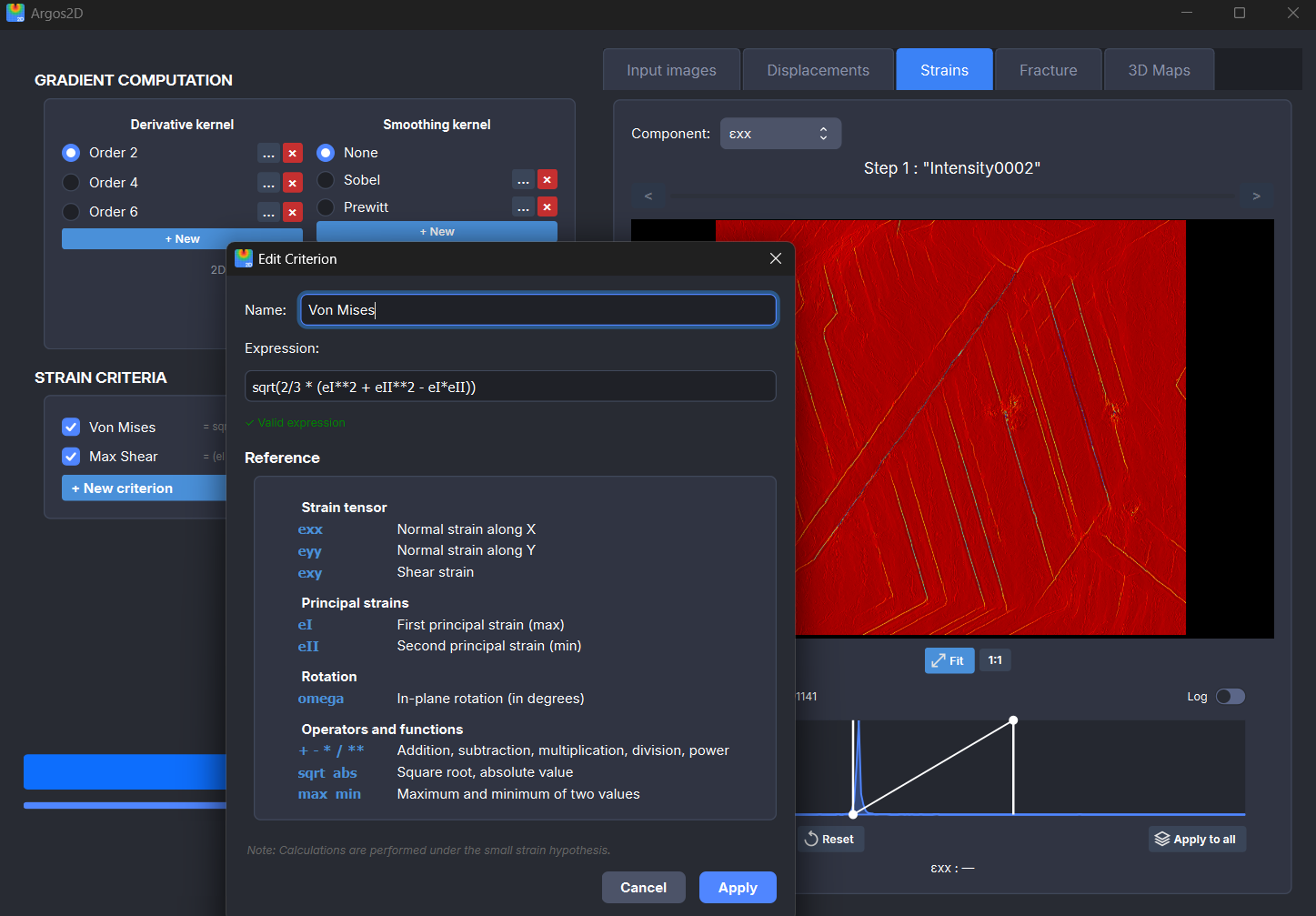
Dataset from A. Rouwane, D. Texier, J.-N. Périé, J.-E. Dufour, J.C. Stinville et al., Optics and Laser Technology, Vol. 177, 2024. Courtesy of Damien Texier.
Large-area analysis from tiled acquisitions.
Mosaic Stitching & Batch Mode
Assemble multi-tile acquisitions into a seamless mosaic before running DIC.
- Automated grid layout — row/column organization with configurable overlap, handles missing tiles
- Batch mode — process each tile pair independently without stitching, for high-throughput analysis
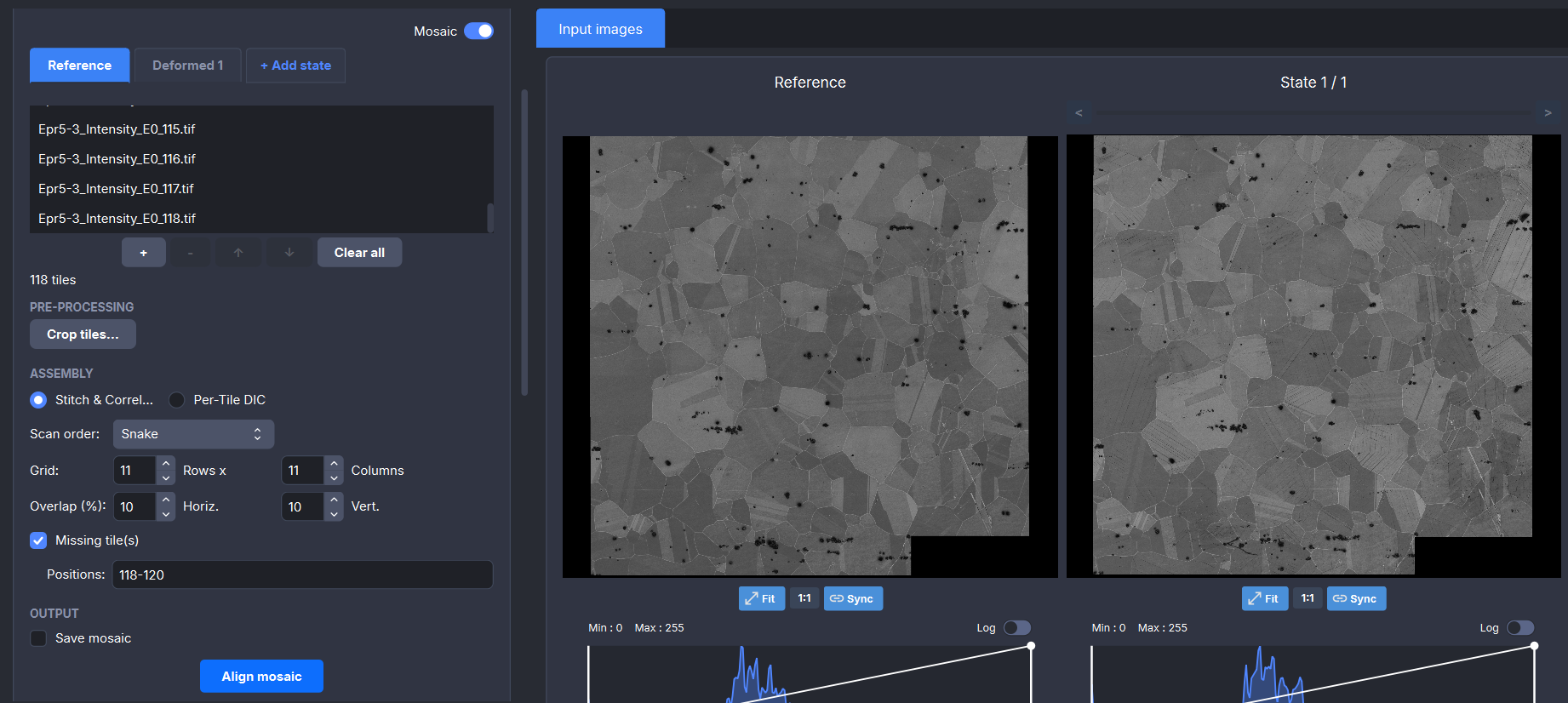
Dataset from A. Rouwane, D. Texier, J.-N. Périé, J.-E. Dufour, J.C. Stinville et al., Optics and Laser Technology, Vol. 177, 2024. Courtesy of Damien Texier.
Core engine specifications
Under the Hood
Everything runs on your NVIDIA GPU, from pixel search to sub-pixel optimization and neural inference. Your images never leave your computer.
Get Argos2D
The full correlation engine: displacement, strain and every correlation parameter.
Download free portable versionEverything in the free edition, plus Heaviside enrichment, the fracture tab and mosaic stitching. Neural correlation is available as an option.
Request a licenseAlready have a key? Unzip the free edition and open Help → About Argos2D → Activate full edition. Argos2D validates your key online, then downloads and installs the full edition.
| Feature | Free | Full |
|---|---|---|
| Correlation engine CUDA-native, multi-GPU, hierarchical and FFT pixel search | included | included |
| Displacement fields Sub-pixel IC-GN, bilinear / bicubic / B-spline interpolation | included | included |
| Strain post-processing Full tensor, selectable gradient kernels, custom strain criteria | included | included |
| Complete parameter set Subset, spacing, search area, NLC filter, ROI and mask, GPU selection | included | included |
| Image series and field export Reference plus any number of deformed images; every field exported to TIFF | included | included |
| Heaviside enrichment Discontinuity captured inside the subset; twinning mode | not included | included |
| Fracture tab Crack opening and direction, crack angle, screw / edge decomposition | not included | included |
| Mosaic stitching Multi-tile assembly, global position optimisation, batch mode | not included | included |
| Neural correlation (xR-DIC) Licensed option: dense per-pixel field, computed locally on the GPU | not included | option |
| In-app update notifications Downloading an update requires a license key | not included | included |
System requirements
- Windows 10/11 (64-bit)
- NVIDIA GPU (minimum: Turing generation, e.g. GTX 16xx / RTX 20xx)
- NVIDIA driver 580 or newer (CUDA 13)
Questions, quotes, academic pricing: contact@argos-correlation.com